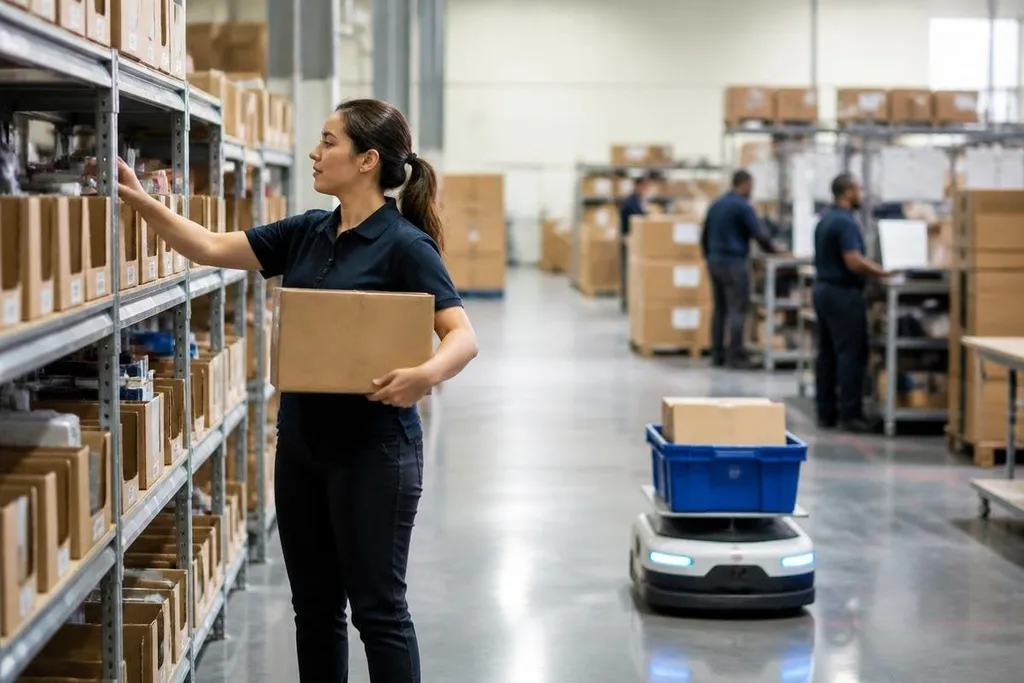
Robots can move a box, inspect a part, or carry tools, but a job usually includes many tasks around that work. That split helps explain why automation may change what people do before it removes whole roles.
Quick read
- Robots handle repeatable physical tasks
- People still manage exceptions and decisions
- New roles grow around setup, repair, and safety
Jobs are bundles of tasks
A warehouse worker may pick items, check labels, answer a stock question, clear a blocked path, and train a new colleague. A mobile robot can carry shelves or bins, but it doesn't take on that full set of duties.
The same pattern appears in factories. A robot arm may load a machine at a fixed pace, while a person checks tool wear, changes the work order, and deals with parts that arrive in the wrong position.
That division matters because companies rarely automate a whole job in one move. They start with a task that is repetitive, costly, hard on the body, or easy to measure. The rest of the role stays with people until the system can handle more cases.
Where robots fit best
Robots work well when the setting stays controlled. A camera can check whether a part is present.
With a known shape, the gripper can pick an item. On mapped routes, a wheeled robot can move and stop when its sensors detect an obstacle.
Those limits shape the work around the robot. Someone has to set the task, watch the system, check failed actions, and decide what happens when the scene differs from the robot's training data.
Physical support remains part of the job. Batteries need charging or swapping. Sensors need cleaning. Wheels, belts, joints, and grippers wear out. Each task can create work for technicians, supervisors, software staff, and safety teams.
Robot jobs will still change when the system works well. A worker may spend less time lifting and more time checking robot output, fixing blocked routes, or moving to tasks that need judgment and communication.
The new work around automation
Automation can reduce demand for some tasks while raising demand for others. A company that installs mobile robots may need people who map routes, set speed limits, inspect charging points, and connect the fleet to its warehouse software.
That does not mean every worker moves into a technical role. Training can be practical and narrow. A person may learn how to restart a robot after a safe stop, read a fault code, or check that a load sits inside the robot's rated limit.
The change also depends on who controls the system. If a company uses robots to remove the hardest lifting, workers may get safer duties. If it uses them to raise output targets without changing staffing or training, the same system can increase pressure.
Job claims need a named task and a working system behind them. Robot 24 can point you to the robot, workplace, and human duties in a report, so you can tell a tested job change from a product demo.
What robots still struggle with
Unplanned work remains difficult. A pile of mixed objects, a damaged package, a wet floor, or a person stepping into a robot's path can break the assumptions that made the task easy to automate.
Remote operators can handle some cases, but that adds people back into the process. The operator may sit in another building and act through a camera feed, yet someone still needs to make the decision and accept responsibility for the result.
The open question is speed. If robots take on more tasks each year, will new work grow fast enough for people whose old tasks shrink? The answer will depend on training, pay, local labor demand, and how companies set their targets.
A practical test for a job change
Use these checks when a company says a robot will replace a role:
- List the tasks: separate the repeatable work from decisions, exceptions, and customer contact.
- Check the setting: ask how the robot handles changed lighting, blocked routes, mixed objects, and damaged goods.
- Find the human work: identify who loads, checks, repairs, supervises, and handles failures.
- Ask about training: look for named instruction, paid time, and a clear path to the new duties.
- Measure the result: compare output, injury rates, staffing, stoppages, and maintenance after deployment.
I expect most early changes to appear as redesigned jobs, not empty workplaces. The test is whether people gain safer and better-paid work, or whether the robot only lets a company demand more from the same team.
That result will show up in the tasks companies keep, the skills they teach, and the number of people needed beside each robot.